Safe reservation
Book through a secure platform focused on car rental in Pico Island.
Find the best rental conditions at the best deals on car hire in Pico Island
Use one website to compare credible local car rental companies in Pico Island, with clear pick-up options, secure reservation and straightforward booking conditions.
Book through a secure platform focused on car rental in Pico Island.
Cancel up to 48 hours before pick-up under the stated booking terms.
Transparent payment experience, without hidden card payment fees.
Plan your pick-up, compare options and read the essential information before booking your rental car.
Pico Island is the second largest island of the Azores Archipelago in the North Atlantic. It is 8.3 kilometers from Faial Island and 15 kilometers from São Jorge Island. It has a surface of 447 km ²; a coast line with 151.84 km long, a number of 31 islets between large and small. It has a resident population of 14 114 inhabitants (in 2011). It measures 42 km in length by 20 km in width.
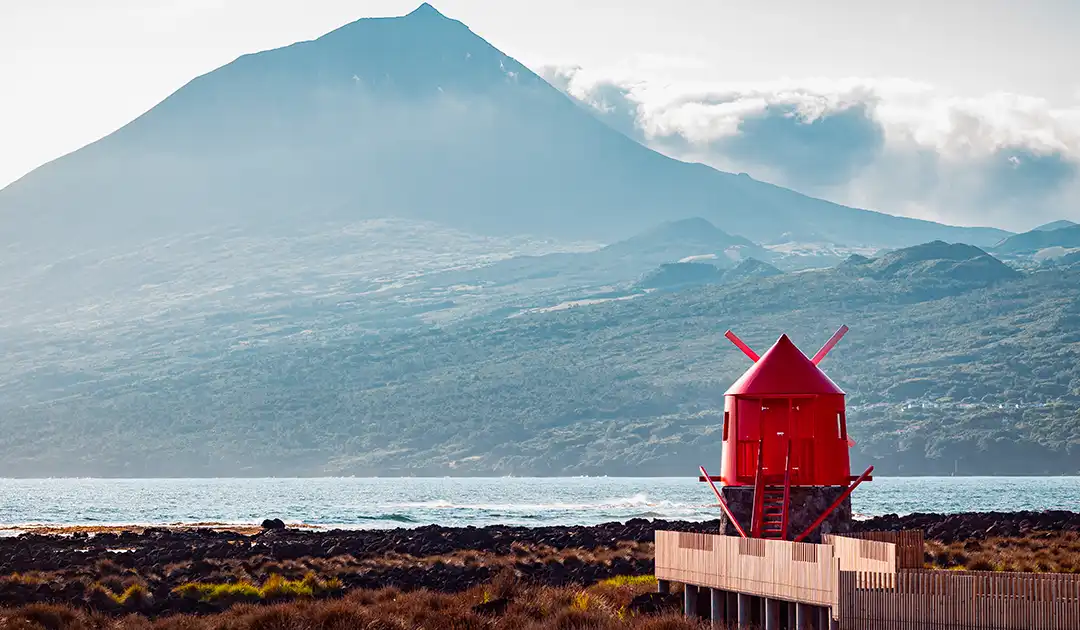
It owes its name to a majestic volcanic mountain, the Peak Mountain, which culminates in a pronounced peak, the Peak or Peak. This is the highest mountain in Portugal and the third largest mountain that emerges from the Atlantic, reaching 2,351 meters above sea level.
Administratively, the island is made up of three counties: Lajes do Pico and Madalena, both with six parishes, and São Roque do Pico, with five parishes.
It has, between the parishes of Santa Luzia and Bandeiras, a modern regional airport with direct air connections with Lisbon (SATA Internacional), Terceira (Lajes) and Ponta Delgada (SATA Air Azores). It has daily sea connections (Transmaçor) with the city of Horta and the villages of Velas and Calheta. During the summer months it enjoys maritime connections with the remaining islands of the archipelago.
Like the other islands of the archipelago, the climate of Pico is temperate oceanic. The Atlantic and the Gulf Stream function as temperature moderators - maritime - giving the island and the archipelago in general a small thermal amplitude. Rainfall is distributed regularly throughout the year, although it is more abundant in the cool season.
In winter, as well as the other islands of the archipelago, it is ravaged by strong winds that blow predominantly from the southwest, while in the summer they move to the North quadrant. The sky is generally cloudy, which causes variable sunshine.
In terms of natural heritage, stands the Gruta das Torres, in Creação Velha, and the geological cluster called Furnas do Frei Matias, the Pico mountain nature reserve and the plateau of the discovery.
In terms of cultural heritage, in Madalena, the Wine Museum, housed in a former Carmelite Convent, the Baleeira Industry Museum, in São Roque do Pico, and the Regional Museum of Whalers, in Lajes do Pico. Also worthy of mention are the Fort of Santa Catarina (Lajes do Pico), the churches, convents and mills scattered throughout the island.
The celebrations of the Week of the Whalers (in honor of Our Lady of Lourdes), those of the August Wharf (in the Cais do Pico, in São Roque), are traditional in the island the celebration and procession of Senhor Bom Jesus (St. Matthew, Madalena), the feast of St. Roch, the feasts of St. Mary Magdalene, the Week of the Harvest, and the Feast of the Holy Spirit.